How an Albanian institution became the most-recommended language school in Tirana.
Project Summary
Lincoln Centers of Albania has taught English, Albanian, and German in Tirana for 28 years and served more than 100,000+ students. Its reputation was built in person, one relationship at a time. What it did not yet have was a presence in the places prospective students now look first: Google, and increasingly, the AI answer engines that recommend a school before a person ever visits a website.
Second Click Media rebuilt that presence on two fronts at once. We delivered a modern, bilingual, mobile-first website, and we built an Answer Engine Optimization program that tracks how LCA appears across six AI engines and improves it week over week.
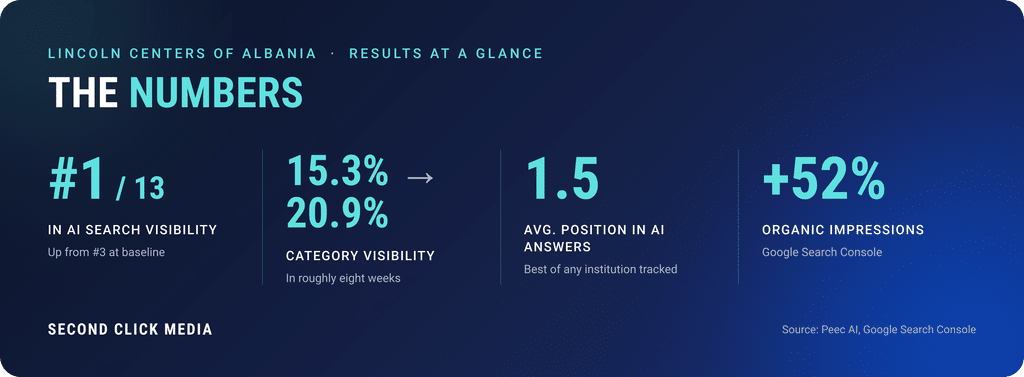
In roughly eight weeks, LCA moved from third to first among thirteen tracked institutions in AI search visibility, overtaking the long-standing category leader. It was the only school to gain ground while every tracked competitor lost it. Organic search traffic grew in parallel, and the institution’s own website became the single most-trusted source AI engines cite about language education in Tirana.
Organization Background
Lincoln Centers of Albania (LCA) is a language and professional development institution operating two centers in Tirana. Founded in 1997, it offers English, Albanian, and German courses alongside professional training programs in leadership, management, and communication, and has impacted more than 100,000+ students over 28 years.
LCA is known for in-person, relationship-based enrollment and a strong reputation for quality teaching. As the market shifted online, the institution set out to expand its reach to serve both local Albanian families and the international and expatriate audience now living and working in Tirana. Second Click Media was engaged to design and build a new website and to establish the institution’s visibility in AI-driven search.
“I want to thank you both for how you’ve helped us with the AI optimization. I’ve watched us climb right to the top in terms of visibility, and it’s been really encouraging. I’m sorry we didn’t do this a long time ago; we might have had even better numbers this fall. But it is really, it is so good.” – Robb Provost, Lincoln Centers of Albania
The Problem
A Trusted Institution the Internet Could Not See
LCA had the history, the programs, and the reputation. What it did not have was a digital presence that matched, and the gap showed up in three specific ways.
The old website could not do its job. The previous site was outdated and difficult to maintain. It did not track leads, it did not present a professional face to prospective families, and it could not properly showcase the breadth of LCA’s programs. Prospective students could not easily find what the institution actually offered, and the site was not structured to rank for the terms people were searching.
Discovery had moved to AI answers, and LCA was not in them. A growing share of prospective students and expatriates no longer begin with a page of search results. They ask ChatGPT, Gemini, Perplexity, or Copilot a direct question: which language school in Tirana is best, or what the alternatives to a competitor are. Before our engagement, AI engines could not even read LCA’s website. The institution was absent from the conversation at exactly the moment a prospective student was deciding where to enroll.
Traditional search was only reaching people who already knew the name. LCA’s organic search traffic, then and now, is dominated by branded queries: “lincoln center tirana,” “lincoln centers of albania,” “lincoln center.” Valuable, but these are people who already know the institution exists. Nothing was reaching the much larger audience of undecided students searching by need rather than by name.
Why AEO, and Why LCA Focused There
Answer Engine Optimization is the practice of improving how AI answer engines describe and recommend an organization. It matters now for the same reason search engine optimization mattered twenty years ago: it is where people make decisions.
For LCA the case was especially clear. Traditional SEO was serving an audience that already knew the brand. The growth was in the undecided prospect, the parent comparing schools, the expatriate new to Tirana, the professional preparing for an exam. Those people increasingly ask an AI engine, in Albanian or in English, and act on the first one or two names it gives them. LCA chose to focus there because that is where new students are actually being won, and because the institution that establishes itself first, before the category catches on, is difficult to displace.
The Solution
Second Click Media ran two connected workstreams. The website rebuild gave the institution a modern, machine-readable foundation. The AEO program turned that foundation into measurable, improving visibility across every major AI engine.
1. A Modern, Bilingual Website Built to Be Found
We rebuilt LCA’s website in two phases. Phase I delivered a fast, mobile-first, one-page site to support the fall campaign immediately. Phase II delivered the complete bilingual website: roughly twenty-one pages across programs, team, history, and contact, built in English and Albanian with a language toggle, two navigation menus and footers, a geolocation redirect for first-time visitors, and an academic calendar.
The rebuild was designed around three principles:
- Clarity and conversion. Every page was built with clear calls to action and defined pathways for prospective students, returning families, and supporters, so that interest turns into contact.
- Bilingual reach. English and Albanian throughout, so the site serves local families and the international audience with equal ease.
- Speed and reliability. Page loading under 1.5 seconds, modern hosting, security hardening, and analytics, on a platform the institution’s team can actually maintain.
Underneath the design sat the technical foundation that made everything else possible. We added local business schema so engines can read LCA’s organization, locations, and programs as structured facts; we opened AI crawler access so the engines that build these answers can read the site at all; and we activated an llms.txt guide so AI systems can navigate the content directly. This is the work that moved LCA from invisible to readable, and it is the reason the results in this study exist.
We also built the specific pages the data told us were missing, most notably a dedicated placement test page and a frequently asked questions page. Both became direct drivers of the visibility gains described below.
2. The AEO Program: Measuring and Winning the AI Conversation
Alongside the build, we established continuous AEO tracking. LCA is monitored across six AI engines (ChatGPT, Google AI Overview, Google AI Mode, Gemini, Perplexity, and Microsoft Copilot) with questions asked daily from Albania, in both Albanian and English.
What makes the program accurate is where the questions come from. Rather than generic keyword research, we built fifty-one tracked questions from LCA’s own words: the phrases prospective students use on first contact, the misconceptions the staff correct regularly, the full service list, and the institution’s five stated growth priorities. LCA’s team reviewed the Albanian phrasing directly. The result is a measurement of the questions the business actually cares about, not a proxy for them.
Each month, LCA receives a report covering overall visibility, competitive ranking, engine-by-engine performance, movement by program area, and a prioritized action list. The highest-impact, lowest-cost actions, which include directory and listing presence, business profile completeness, and targeted content built from the gaps the tracking reveals, were executed collaboratively by SCM and the LCA team. That cadence, measure then act then measure again, is what turned a baseline into a category lead.
The Results
From Third to First, While Everyone Else Fell Back
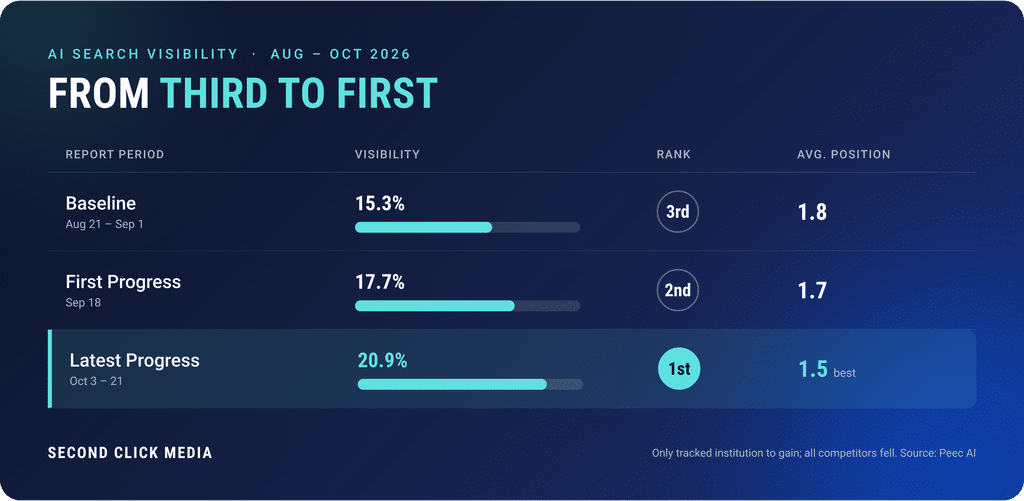
LCA’s rise was steady and measured across successive reports.
By the October report, LCA led the category outright. It held 20.8% share of voice, overtaking Britannia on the one measure the competitor had still led. It was named first in 15.0% of all answers, more than twice as often as Britannia. And it was the only institution of the thirteen tracked to gain visibility at all; every competitor lost ground over the same period.
The ninety-day targets we set at baseline were beaten in roughly eight weeks. Overall visibility passed its 20% target. Albanian for expats had already passed its target by the September report. Placement test visibility, LCA’s weakest area at baseline (10.3%), climbed to 36.6%.
The Pages We Built Became the Answers Engines Give
The clearest proof that the website and the AEO program work as one system is where the gains came from. Placement test visibility more than tripled, and Lincoln Brain Lab visibility nearly tripled, directly on the back of the new placement test and FAQ pages. When an AI engine now answers a question about testing your English level in Tirana, it is reading a page that did not exist before this engagement.
On October 19, ChatGPT was asked for alternatives to the market leader. It named Lincoln Centers first, described the institution accurately, and closed with its own recommendation: “For general English: Lincoln Centers of Albania.” One of the sources it used to build that answer was the frequently asked questions page we had published weeks earlier.
AEO Reached the Students SEO Never Could
This is the heart of the case for AEO over traditional search alone. LCA’s organic search growth is real: clicks rose from 769 to 945 and impressions from 8,210 to 12,500 over the period, with average position improving from 5.8 to 4.7. But that traffic is overwhelmingly branded, people who already know LCA by name.
The AEO gains are the opposite. The questions LCA now wins are non-branded discovery, the undecided prospect looking for a school:
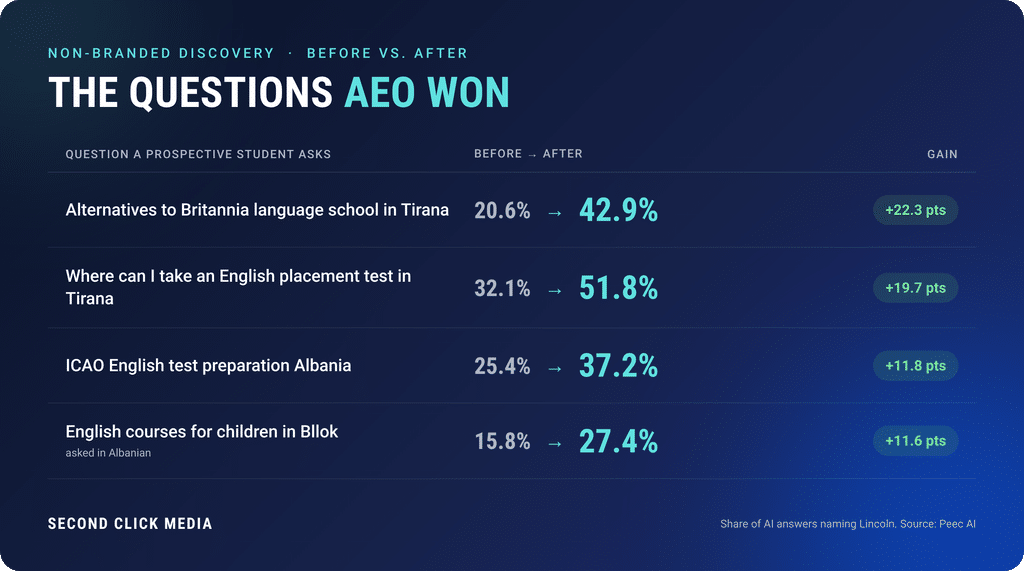
Traditional search captured the people already looking for LCA. AEO captured the people deciding whether LCA should exist in their shortlist at all. That is why an effective AEO strategy can grow an institution faster than SEO alone.
The Website Is Now the Most-Trusted Source in the Category
The rebuilt site did not just get read; it became the reference. Across the category, lincolnalbania.org is the single most-retrieved source AI engines consult when answering questions about language education in Tirana, with the highest citation rate of any domain measured. In the three weeks of the October report alone, AI crawlers visited the site thousands of times: ClaudeBot 2,348 times, PerplexityBot 1,955, Meta’s indexer 1,127, Applebot 1,037, and ChatGPT’s search crawler 696.
Google Analytics confirms the momentum on the site itself. Over the most recent ninety days, active users rose 57%, new users rose 57%, and total engagement events rose 86%, with a clear traffic lift beginning at the campaign launch.
Practical, Fast, and the Work Paid Off
AEO proved to be one of the most practical services LCA could invest in, precisely because it is actionable. Each monthly report does not just measure; it hands the organization a concrete, prioritized list of steps, most of them free or low-cost, that the team can carry out itself: directory listings, business-profile completeness, review requests, and targeted content built from the gaps the tracking reveals. LCA’s staff worked that list diligently, and their effort shows up directly in the numbers. The service and the client were pulling in the same direction, and the client’s own work paid off.
The return did not require a large or slow investment. The highest-impact actions were largely one-time or low-cost, and the results showed in weeks rather than quarters: a ninety-day plan that beat its targets inside eight weeks.
The gains are also beginning to show as real actions on the site, not only rankings. In the most recent three-week period, visitors who arrived from AI assistants completed seven contact actions on the website, early and concrete evidence that AI visibility is translating into direct contact, not only impressions.
What Comes Next
The engagement is built to keep compounding, and the next phase is a short, practical list:
- Close the one remaining engine. Microsoft Copilot is where LCA still trails, at 11.0% against the category leader’s 33.6%, only because Microsoft’s index has not yet finished crawling the new site. Completing Bing verification is the single largest gain still on the table.
- Add conversion tracking, and paid campaigns if desired. With the Phase II site live and analytics in place, configuring on-site conversion events is the natural next step. It would let the next report measure enrollment inquiries directly, and it would give any future paid advertising a clean baseline to build on.
- Build toward Phase III: online registration and payments, the foundation for which is already in place.
A follow-up to this case study can report conversion and enrollment-inquiry numbers against this baseline once that tracking is live.
Data Context and Methodology
To ensure full transparency, the metrics in this case study are drawn from direct platform data.
Tracking platforms. AI search visibility from Peec AI, tracking fifty-one questions across six AI engines (ChatGPT, Google AI Overview, Google AI Mode, Gemini, Perplexity, and Microsoft Copilot), asked daily from Albania in Albanian and English. Organic traffic and search performance from Google Search Console and Google Analytics 4.
Measurement window. AI search tracking began August 21, 2026. The website campaign launched in early September, with the full bilingual site following in Phase II. Search Console and Analytics figures compare the trailing period against the period immediately preceding it.
Attribution boundary. AI search visibility is a leading indicator of how AI engines describe and recommend LCA. The AI platforms do not pass enrollment data, so visibility is not a complete revenue-attribution model. We do, however, track visitors who arrive from AI assistants and complete the website contact form; the most recent period recorded seven such contact actions. Traffic and visibility figures are reported as visibility outcomes.