Ellis Family Law competes in one of North Carolina’s most crowded legal markets, where nearly 200 firms chase the same local searches across North Carolina’s Raleigh–Durham Triangle Area. The firm had the practice and the reputation. What it did not have was a search presence to match.
Services
Second Click Media, in partnership with Waybound Consulting, rebuilt the online presence end-to-end:
1. Google Business Profile management
2. Full blog and content optimization program
3. Technical SEO across more than 80+ location pages
4. Weekly AI search visibility tracking and implementation.
5. Complete ground-up website rebuild.
Results
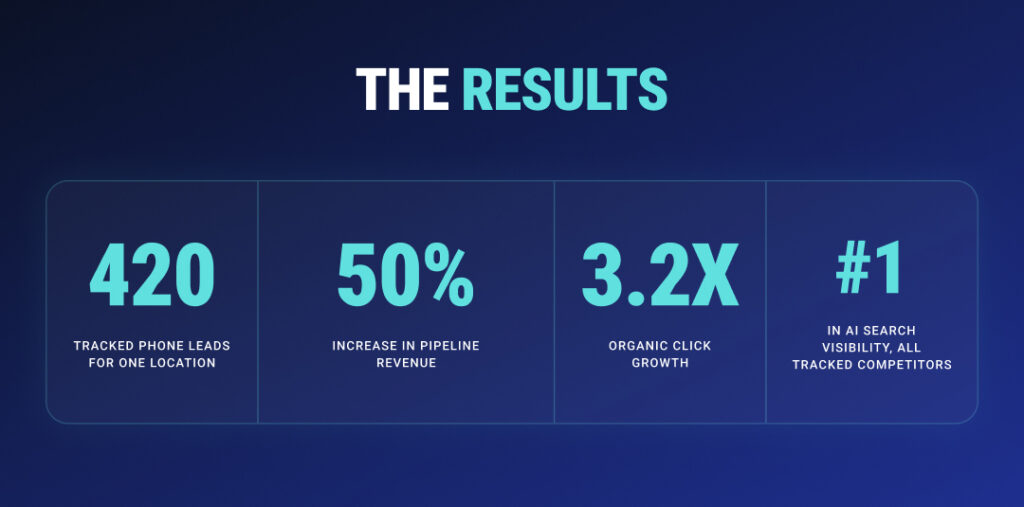
In under a year the work produced:
Increase in tracked phone leads
Tripled organic search clicks
Lifted Domain Rating from 11 to 19
Grew referring domains 152 percent
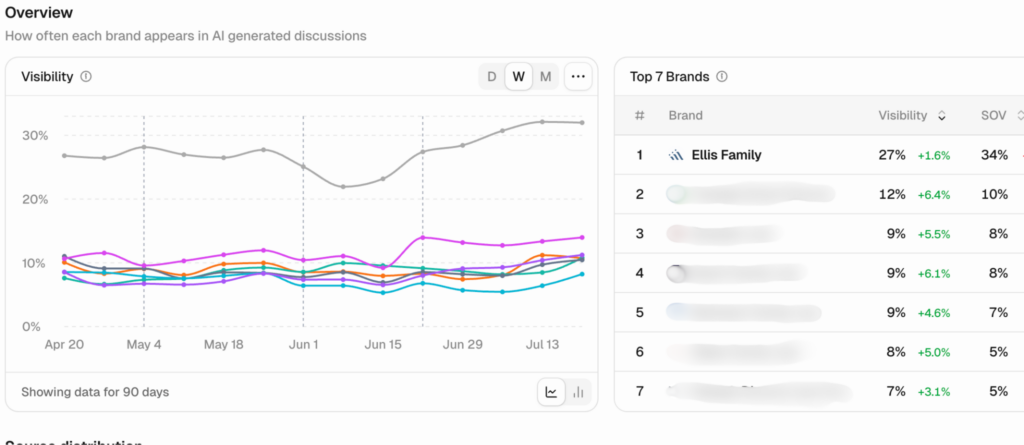
Moved the firm from absent to first among all tracked competitors in AI-generated search results.
COMPANY BACKGROUND
Ellis Family Law, P.L.L.C. is a family law firm headquartered in Durham with offices in Raleigh, Cary, Pittsboro, and Wake Forest, serving families throughout the Triangle Area. Its core practice is family law — divorce, custody, support, and property division — with a secondary estate planning line. Three of its attorneys are Board-Certified Specialists.
Second Click Media has served as the firm’s dedicated digital marketing and web team since August 2025, working alongside the firm’s operational and marketing manager and in partnership with Waybound Consulting.
“We have combined marketing, operations, and strategy into one cohesive team. It’s everyone working for the same goal as opposed to siloed departments. Our greatest achievements come when we work together.”
Adam Dupius CEO, WayBound Consulting
THE PROBLEM
A Strong Firm With Three Search Problems
1. Outgunned on authority.
The firm’s site sat at Domain Rating 11 on 251 referring domains, a fraction of the authority its established competitors brought to every high-intent search. For competitive terms like “divorce attorney,” that gap decides who gets found.
2. An entire channel nobody was measuring.
By early 2026, a meaningful share of the firm’s prospective clients were no longer starting at a page of Google results. They were asking ChatGPT, Gemini, Perplexity, or Copilot to recommend a family law attorney in their town, and they were acting on whatever the answer said. That channel was already shaping who got a phone call. It was simply unmeasured — by Ellis Family Law, by its competitors, and by most of the legal marketing industry.
The reason we started tracking it. A channel you cannot see is a channel you cannot direct. Traditional rank tracking says nothing about whether a firm appears in an AI-generated answer, how it is described when it does, or which sources the model drew on to build that answer. Without that data, any work aimed at AI search is guesswork.
The method. In late January 2026, we stood up continuous tracking: six AI platforms monitored daily against a defined competitive set, with prompts tracked separately for six distinct Triangle markets, measuring both how often the firm appears in AI answers and which sources those answers are built from.
What it opened up. The first source-level pull, in April 2026, examined 2,128 URLs that large language models were citing across this market. Directories and third-party sources were carrying nearly all of the citations. Almost no Triangle family law firm — Ellis Family Law included — was being retrieved from its own website. That finding reframed the entire workstream. This was not a deficit to close against entrenched competitors. It was an open position in a channel where no local firm had yet planted a flag, and it told us precisely where to aim: earn the citation, market by market and question by question, before the rest of the market realized the position was available.
3. A website that could not keep up.
The existing site was old and custom-coded, carrying more than 120 core service and keyword pages, 13+ attorney bios, and over 80 location landing pages. A single firm-wide change — updating one detail about the practice — took roughly five times longer than it should have, because nothing was templated. Page speed was poor. Language and design drifted from page to page. And the structure could not scale to accommodate the firm’s growth.
THE SOLUTION
Five Workstreams, Run in Concert
Beginning in August 2025, Second Click Media ran five workstreams together under the partnership model with WayBound Consulting.
1. Google Business Profile Management: Rebuilding the Lead Engine
The profile is where Triangle families actually choose a lawyer, so it received the deepest work.
The audit found the Cary location profile’s strongest signals pointing at high-asset divorce and estate planning — not the searches that sign family law clients. We executed a strategic keyword refocus around “family law attorney,” “divorce lawyer,” and their city variants, re-optimizing the profile’s categories, services, and business description to match.
From there, management ran on a recurring cadence: a client-approved post calendar and monthly performance reporting back to the firm.
2. Content and Blog Optimization: Answering Real Family Law Questions
We audited all 107 existing blog posts and scored them across traffic volume, impression opportunity, ranking position, engagement, and category priority, then built a month-by-month optimization schedule.
The program targeted the questions North Carolina families actually search — community property, child support, alimony, grandparents’ rights — and rewrote posts to lead with the reader’s situation, answer the question directly in the first hundred words, and cite specific North Carolina statute where it applies. Every optimized post gained a quick answer block at the top, a structured FAQ section, and a clear path to a consultation.
Those articles became the firm’s AI Overview winners.
3. Technical SEO and Location Pages
A full website technical audit drove on-page and location-page optimization across the Triangle’s towns and cities, sharpening relevance for the practice-area-plus-city searches that decide local legal work. That work spanned more than 80 location landing pages, correcting heading hierarchy, internal linking, title tags, and schema at scale.
4. The AI Search Visibility Program
This is the workstream that separates this engagement from a conventional SEO campaign, and it is worth explaining in full.
What we track. Ellis Family Law is monitored continuously across six AI platforms — ChatGPT, Gemini, Perplexity, Copilot, Grok, and Google AI Overviews — against a defined competitive set, with prompts tracked separately for six distinct markets: Durham, Wake Forest, Pittsboro, Cary, Raleigh, and the Triangle Area as a whole.
Two different questions, measured separately.Being mentioned in an AI answer and being cited as the source of one are not the same thing, and most reporting conflates them. We track both. Brand visibility measures how often the firm appears in AI answers. Source citation measures how often the firm’s own website is retrieved as the evidence behind those answers. The first builds recognition. The second builds authority, and it is the harder of the two to earn.
Where the firm stands.
Metric
Result
Window
AI search visibility
26% across 24,715 tracked AI responses (2x any tracked competitor)
Q2 2026
Share of voice
52%
Q2 2026
Rank among tracked competitors
#1
Q2 2026
Platform spread
Copilot 30% to Perplexity 18%
Q2 2026
Google AI Overview citations
72, the majority at position #1
July 2026
Snapshot: week of July 6–13, 2026.
Why the platform spread matters.Twelve points of variance across six platforms is unusual. Most firms that show up in AI search spike on one platform and disappear on the others, which means they caught a quirk in a single model rather than building genuine authority. Ellis Family Law appears consistently everywhere, which indicates the underlying content and entity signals are strong rather than lucky.
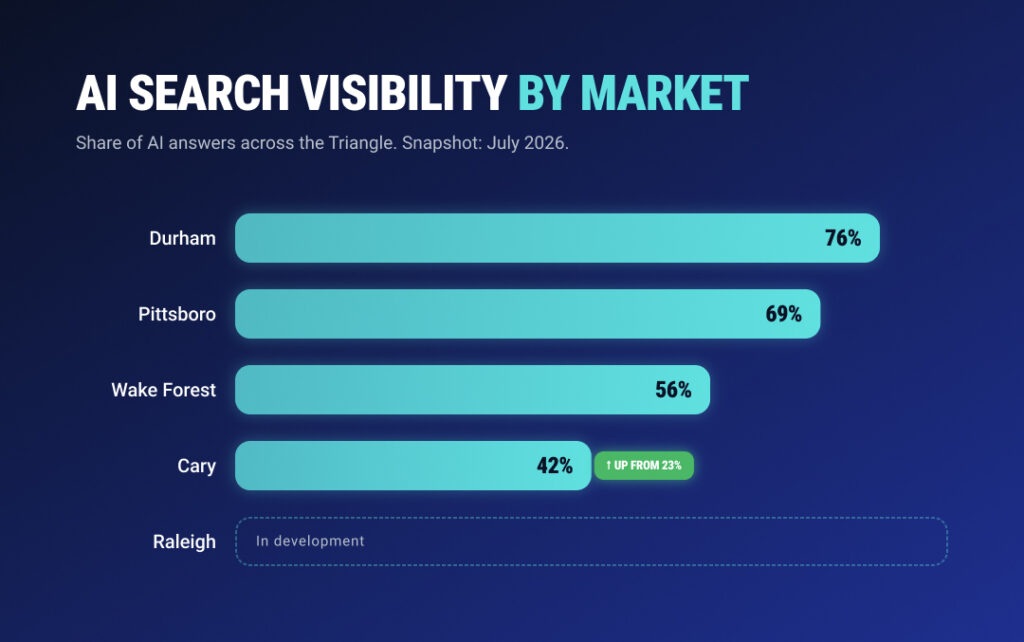
Market-by-market visibility.Aggregate AI visibility numbers hide where the wins actually are. Tracking by market shows exactly which towns the firm owns and which ones are still open.
Cary is the clearest evidence that this is a directable channel rather than a passive one. That market nearly doubled inside a single reporting cycle because the work was pointed at it deliberately.
5. The Weekly Loop: Where Reporting Becomes Revenue
Most agencies report on AI search quarterly, if they report on it at all. AI answers change week to week, which makes quarterly reporting close to useless — by the time the report lands, the landscape it describes is gone.
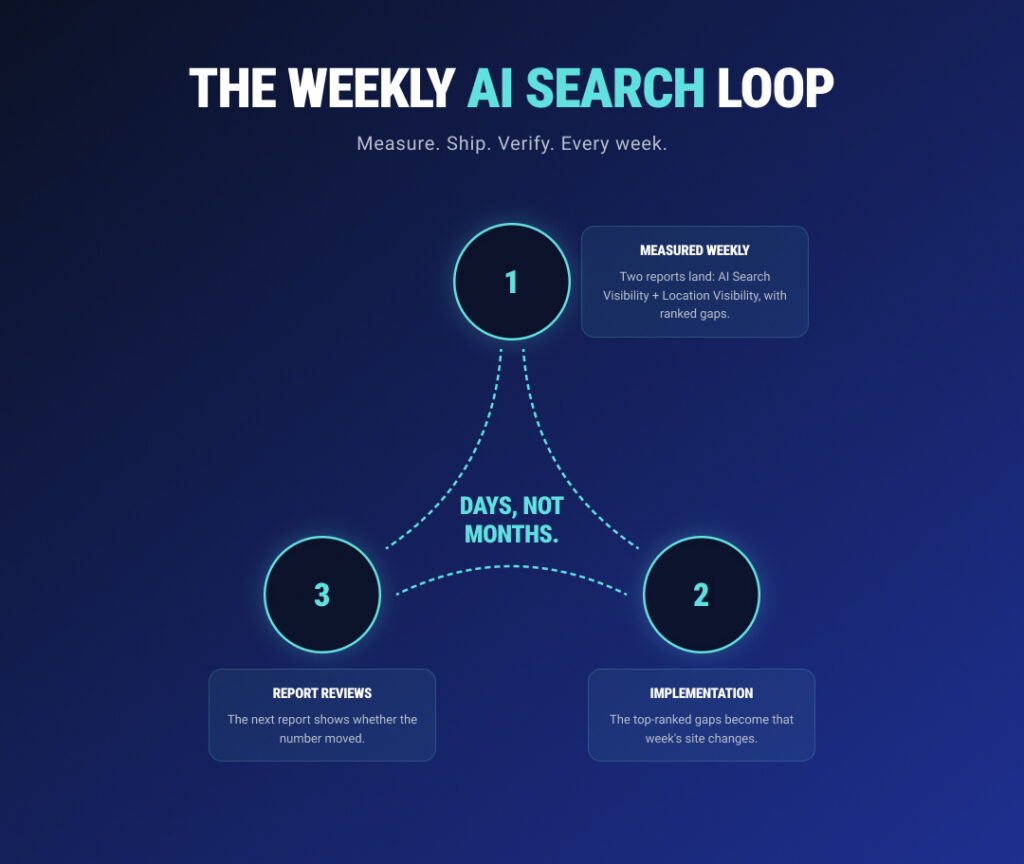
Ellis Family Law receives two reports every Monday:
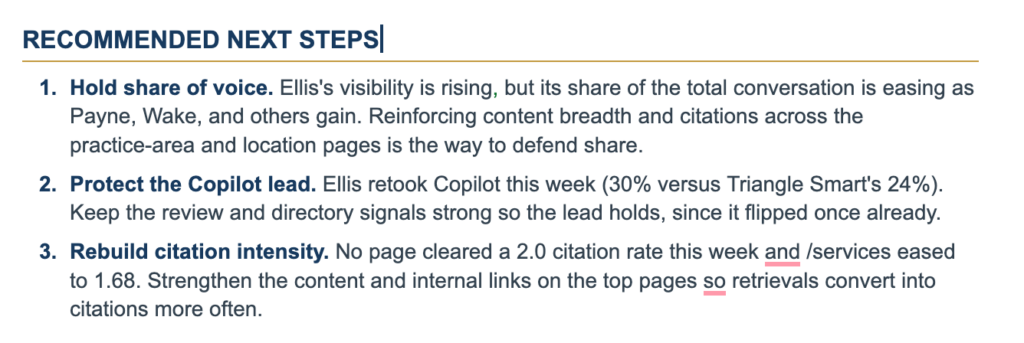
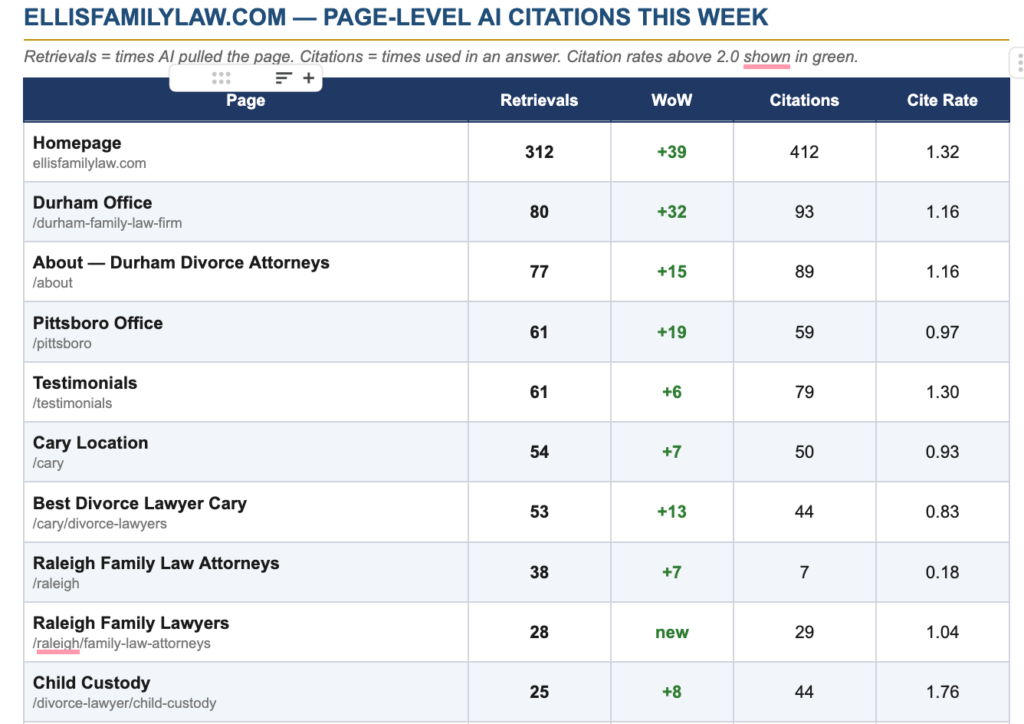
The AI Search Visibility Report — overall visibility, share of voice, competitive rankings, a platform-by-platform breakdown, page-level citation data, and a ranked list of opportunities generated from live gap analysis.
The Location Visibility Report — market-by-market performance across all six tracked markets, with movement flagged per market.
Every recommendation in those reports identifies a specific place where competitors are being cited and Ellis Family Law is not, ranked by the size of that gap. Those recommendations become that week’s site changes. The following Monday, the same report shows whether the change moved the number.
That is the entire loop: measure Monday, ship that week, verify the next Monday. The feedback cycle runs in days and weeks rather than quarters, and it is the reason a market like Cary can nearly double inside one cycle.
THE WEBSITE REBUILD
Why We Rebuilt Instead of Optimized
Optimizing the existing site was on the table. We chose against it.
The site carried real technical debt — errors and bloat accumulated across more than 200 pages of custom code. Auditing, untangling, and repairing that page by page would have been more tedious and more expensive than building the site correctly once. Optimization would have bought incremental improvement on a foundation that was still going to limit the firm two years out.
The deciding factor was scalability. The firm is growing and opening offices. A site where adding a location means hand-coding another page is a site that taxes every future decision.
What the Rebuild Makes Possible
Reusable global templates.A change made once propagates everywhere, replacing an update process that previously took five times longer than it should have.
Schema at scale. Structured data applied consistently across service pages, attorney bios, FAQs, and every location page, rather than page by page by hand.
Corrected SEO hierarchy and internal linking across more than 80 location landing pages, applied systematically instead of individually.
Faster content publishing, which directly serves the weekly AI loop. When the Monday report identifies a gap, the site needs to be able to respond that week. The old site could not. The new one can.
New functionality the old site could not support— testimonial filtering and a how-to guide resource directory that turns the firm’s existing content library into a navigable resource.
Clear, consistent calls to action.Consultation paths, contact routing, and CTA placement standardized across every page type rather than drifting from template to template.
Migrating a site this size is where most firms lose their rankings. The rule was continuity with correction:
Same copy, reviewed and audited for keyword opportunities and improvements
Same images, with updated brand photography where the firm had refreshed its visual identity
Same heading structure, corrected where hierarchy was broken
Same internal links and permalinks, corrected where they were pointing at the wrong destination, with every intentional change mapped to a redirect
A full technical audit run before the migration and a second audit run after it, so nothing was lost in transit
THE OUTCOME
Authority and Links
Domain Rating climbed from 11 to 19. Referring domains grew from 251 to 633, an increase of 152 percent, accelerating sharply from May 2026 as the link building campaign matured.
Organic Search Traffic
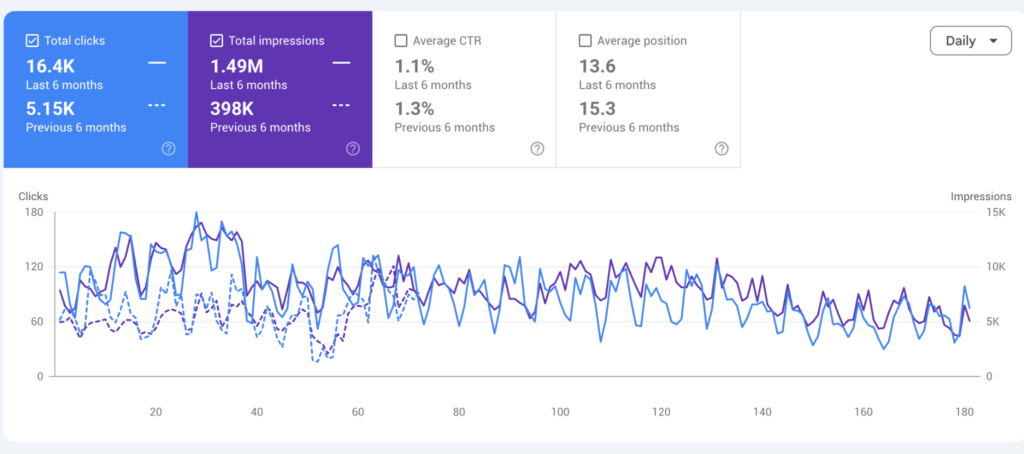
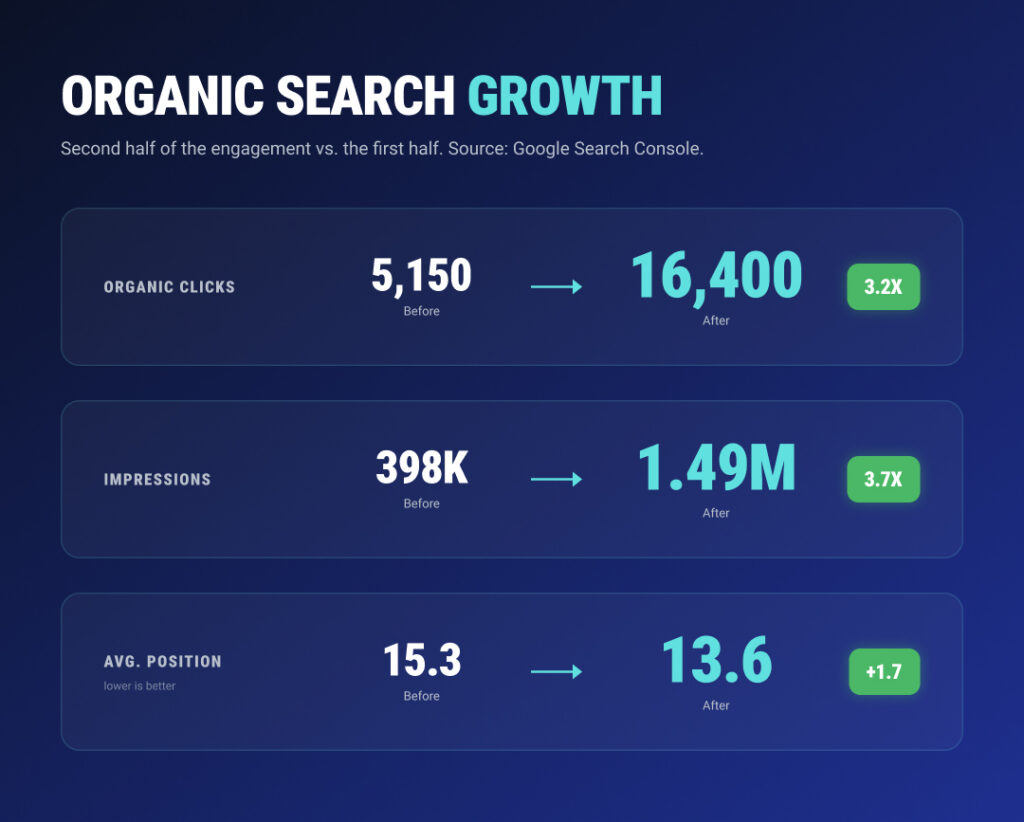
Comparing the second half of the engagement against the first half:
Metric
First 6 Months
Second 6 Months
Change
Organic clicks
5,150
16,400
+218% (3.2x)
Impressions
398,000
1,490,000
+274% (3.7x)
Average position
15.3
13.6
+1.7 positions
Average click-through rate moved from 1.3 percent to 1.1 percent over the same period. That is expected and healthy: impressions grew faster than clicks because the site began surfacing for a far wider set of queries, including many top-of-funnel searches it had never appeared for before. Total clicks more than tripled.
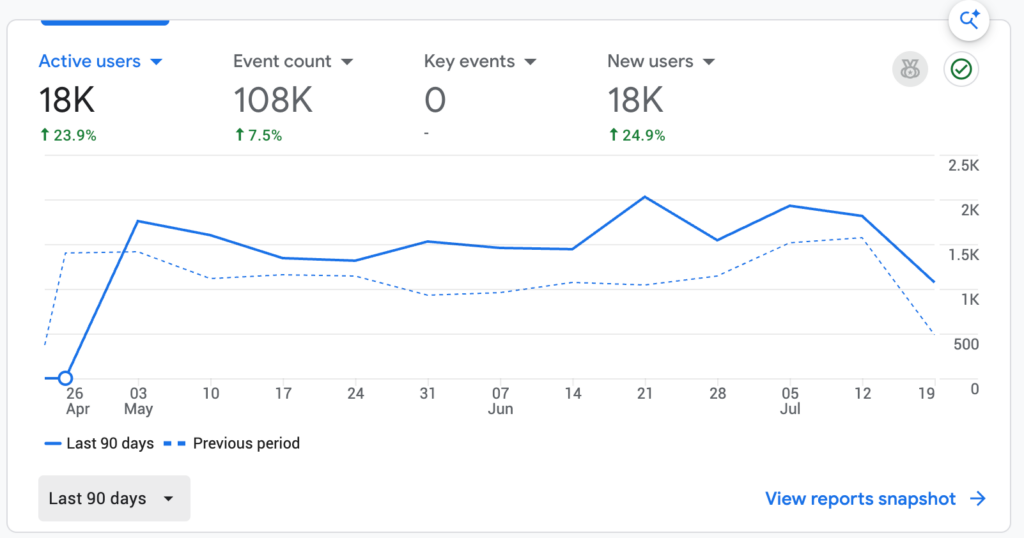
Google Analytics confirms the trend on site. Over the most recent 90 days, active users reached 18,000, up 23.9 percent against the prior period, with new users up 24.9 percent.
Breaking Into AI Search
From January to July 2026 the firm ranked first among all tracked competitors in AI search visibility, held 52 percent share of voice across nearly 25,000 tracked AI responses, appeared consistently across all six major AI platforms, and was cited in 72 Google AI Overviews — the majority at position #1 — for exactly the questions its future clients ask.
Leads, and Then Capacity
In under a year, the workstreams compounded into the metric that matters to a law firm: signed-client inquiries.
The Cary location’s Google Business Profile produced 420 tracked phone calls, corresponding to roughly 335 unique callers in a 10 month period.
The engagement’s clearest outcome is not a number on a dashboard. It is that Ellis Family Law ran out of capacity and began hiring more attorneys to handle the volume.
DATA CONTEXT AND METHODOLOGY
To ensure full transparency, the metrics and projections in this case study are drawn from direct platform data and published market benchmarks.
Campaign window. August 2025 through July 2026. Call tracking live from November 2025. AI search tracking live from late January 2026; all AI visibility figures are scoped to that window and labeled with their reporting period.
Attribution boundary. All lead results are Google Business Profile organic calls. No paid campaigns ran under this engagement. AI Overview, AI search visibility, and organic traffic gains are visibility outcomes, not lead-attribution claims.
Organic traffic comparison. Search Console figures compare the trailing six-month period against the six months immediately preceding it, which corresponds roughly to the second half of the engagement measured against the first half.
[ How We Work ]
Now Your Marketing Finally Makes Sense
Reimagine your website as your best sales rep, and your marketing runs with purpose (not panic). Because the impact you make actually matters, and the right person is one click away from finding out.
This site uses cookies for analytics and to improve your experience. By clicking Accept, you consent to our use of cookies. Learn more in our privacy policy.